
A wide brick-paved street lined with two-story red brick buildings, awnings and lamp posts, palms and young oaks in late afternoon light

Chimney sweeping and cleaning in St. Cloud.

Brushes and rods take the soot and creosote off the flue walls, the smoke shelf is cleared, and the firebox and any stove pipe follow. Phone us, or fill in the form whenever you like.
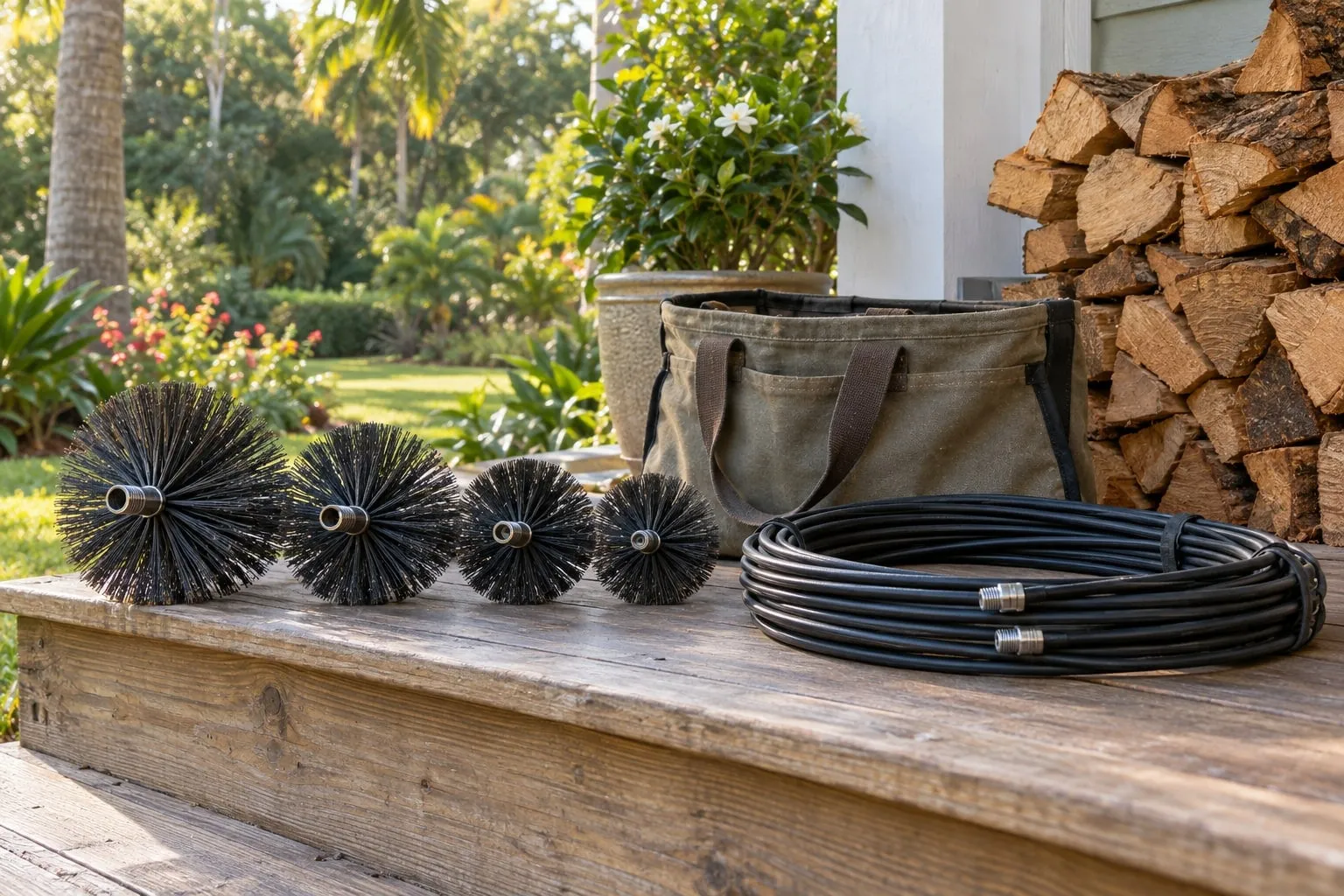
Round chimney brushes of four sizes and a coil of black rod laid on a wooden step beside a stack of firewood
  • Based in St. CloudOsceola County
  • We call youA day is picked together
  • Request formAlways open

How a sweep goes, and why it matters.

What comes off the walls, how to tell when the next sweep is due, and what to settle before the first fire of the cool season.

  1. What comes off the walls.

    Every wood fire coats the inside of the flue. New soot is dry and powdery and comes off with a brush; slow, smoky fires over the years bake it into tar and then a hard glaze that plain bristles barely mark.

    Work starts at the damper and climbs to the cap. The shelf is swept after that and the floor of the firebox last, so what came loose is carried out with us rather than left to burn.

  2. Deciding when the next one is due.

    How you burn sets the pace. A flue fed nightly coats far faster than one lit on a few cold days; a thick or glossy layer says the sweep is late.

    Whatever the use, NFPA 211 suggests one inspection a year, which is how the coating gets noticed, so sweep and inspection often happen in one visit.

    Cold is a short season here. The Kissimmee station, about 9 miles west of downtown St. Cloud, averages 3.2 nights a year at or below freezing and 18.1 at or below 40 degrees (1991 to 2020 normals), so hearths see bursts of use. Even a seldom-lit flue gathers soot, and an idle one can fill with leaves and nests, which is why a yearly look is the sensible default.

  3. What clean walls give you.

    A heavy deposit of creosote may ignite in the flue, and that is among the ways chimney fires begin. Without it, a stray spark finds little fuel.

    Draw improves too. Smoke should rise and leave; in a coated or half-blocked flue it may spill back into the room the instant the damper is opened.

    Fireplaces are old news in this city: the Hunter Arms Hotel, opened on New York Avenue in 1927, had a coquina rock fireplace among its interior features. A hearth that old or one built last year collects soot all the same.

  4. Stoves, inserts and gas log sets.

    A stove turned down for the night smolders, and smoldering smoke makes the heaviest creosote; most of it settles in the connector pipe between stove and flue.

    We clean the full route of the smoke, beginning with the stovepipe and its joints and ending at the cap, with the flue or liner between. Gas appliances are another matter. Florida's Fuel Gas code has a rule for gas: a flue that once vented solid fuel is to be cleaned out before a gas appliance connects to it (501.15.2), and the passage is to be examined before any appliance is replaced (503.5.6). Under the residential code an unvented gas log heater cannot go into a factory-built fireplace unless that unit is tested and listed for it (R1004.4).

  5. At the cap: soot, birds and bats.

    Soot builds up on the cap's mesh as smoke cools, and since that mesh also holds sparks in, a clogged one hurts the draw and works against itself; every visit includes clearing it. Birds and bats also move into flues across Florida. Chimney swifts have federal protection, and excluding bats is illegal from mid-April to mid-August, so an occupied flue is left alone until the season changes.

  6. A smell when the air turns damp and warm.

    Creosote is the likely source. Used flues retain a little, and in heavy wet air, or when the draft runs backward, the smell sinks into the room. When the sweep has taken away the source, a damper kept closed between fires deals with what remains.

Book a sweep

Questions about sweeping.

Short answers, with a source where there is one.

When is the next sweep due?

Go by the thickness of the coating, not the calendar. The yearly inspection NFPA 211 advises shows how much there is and what kind, and a glossy or tarry layer means booking soon.

Sweep first or inspect first?

NFPA 211 spreads inspection over three levels and covers the whole chimney. Soot can hide damage, so one visit usually does both jobs.

What does glazed creosote mean?

Creosote that has set into a smooth, dark, hard crust, mostly where smoke cools slowly, for example in a stove banked overnight. Brushes hardly mark it, so seeing any is a prompt to book.

Do gas fireplaces get swept?

Gas burns without creosote, yet the vent still has to stay clear. A yearly inspection is advised for gas-fired chimneys too, says the Chimney Safety Institute of America, because debris or a nest can block the flue.

Why is the smell worse in humid weather?

Warm, damp air carries creosote odor, and a downdraft pushes it indoors. Remove the deposit and there is nothing left to smell.

How do I book a sweep?

Phone (321) 204-8868, or write on the form lower on this page at any hour. Someone calls you back to set a day.

What has you thinking about the chimney?

Describe it on the form or just phone. Someone rings you back and a day gets chosen between the two of you.

  1. 1Reach us Phone, or send the short form.
  2. 2We call back We ring you and settle on a date together.
  3. 3Roof to hearth The six parts are checked in turn, cap first.
  4. 4You decide We walk you through what we found; any work is your call.

Phone

Phone and say what you need.

(321) 204-8868

Request form

Open day and night

What do you need?

Which service?

About your fireplace

What does it burn?

Reaching you

Best time for the call back

Back

Cool weather on the way, or a storm that may have loosened something?